What does a critter guard actually protect on a Manteca roof?
A critter guard shields the wiring harness, junction boxes and module underside from chewing rodents, nesting birds and denning squirrels.
The wiring that links one module to the next runs exposed underneath a typical Manteca array, tucked just far enough from view that a homeowner rarely inspects it directly. Squirrels moving between the mature trees common in Woodward Park and along Louise Avenue treat that shaded run as a highway, and roof rats gnaw insulation off connectors simply because it is there — a pattern Exterior Prime professionals see across this stretch of San Joaquin County wherever ag dust and almond orchards keep rodent populations dense near rooftops.
Chewed wiring is not a cosmetic problem. A stripped connector can arc, trip an inverter fault, or in rare cases smolder against dry roofing felt, so the guard is really an electrical-safety measure wearing a pest-control hat.
Pigeons complicate the picture further because a nest packed against a junction box traps moisture against the connector during Manteca's damp Tule fog stretch from December through February, accelerating corrosion long before any wire is visibly chewed.
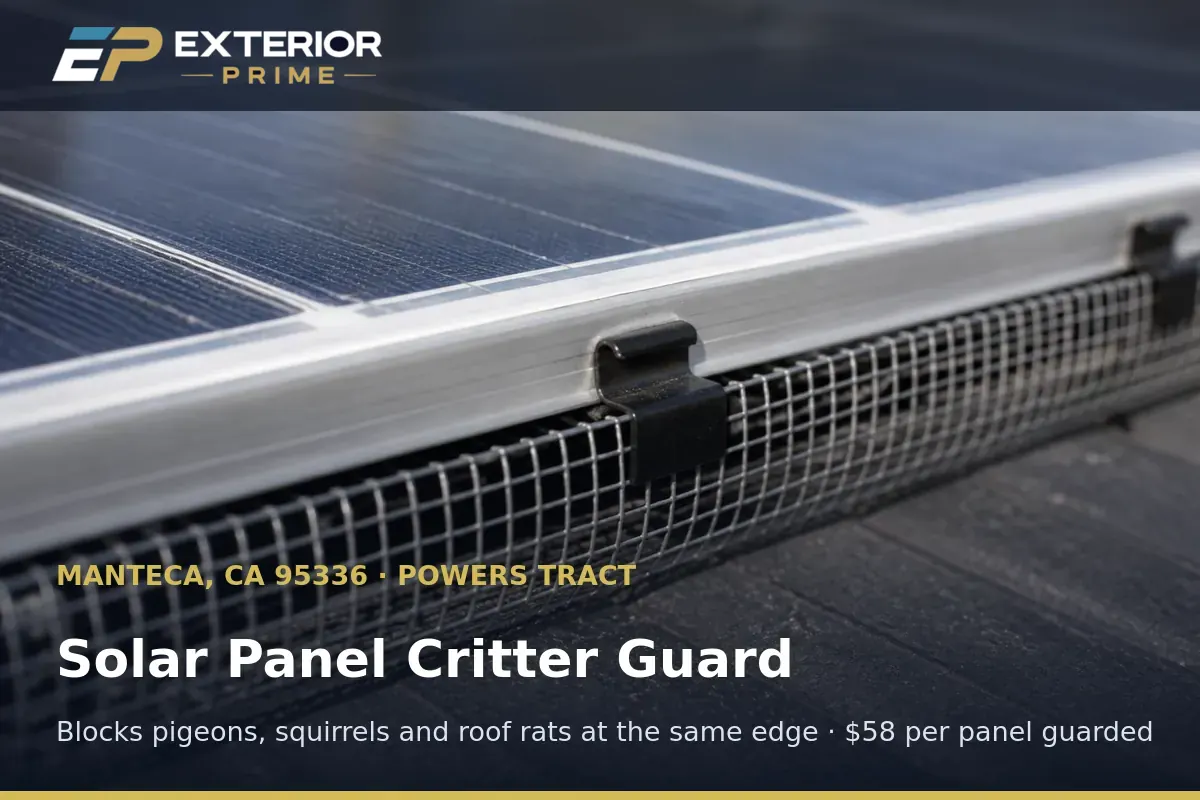
The finished guard wraps every accessible side of the array in mesh anchored to the module frame, leaving the electrical layer underneath fully enclosed and untouched by any animal larger than an insect.
Which animals actually get into Manteca arrays?
Fox squirrels, roof rats and pigeons are the three animals Exterior Prime professionals find under Manteca solar arrays most often.
Fox squirrels are the most common culprit on the tree-lined lots near Union Ranch and Del Webb at Woodbridge, using overhanging limbs to drop onto a roofline and then squeeze under the panel edge where the racking leaves a gap of a few inches.
Roof rats favor the same gap for its warmth and darkness, and because Manteca's agricultural surroundings keep rodent populations steady year-round, an unguarded array rarely stays empty for long once one animal finds it.
Pigeons round out the list, drawn to the same sheltered cavity for nesting rather than for food, and a flock that has already colonized nearby rooftops in the 95336 ZIP will keep probing an open array until it is sealed.
Each species leaves a different signature — squirrels leave chewed insulation and shredded leaf bedding, rats leave gnaw marks and grease trails, pigeons leave twigs and droppings — but the mesh barrier stops all three the same way.
How is a critter guard different from ordinary bird netting?
Consumer bird netting sags and tears under rodent teeth, while a critter guard uses rigid galvanized steel mesh clipped tight to the frame.
Plastic netting sold for backyard use is built to discourage birds landing on soft fruit, not to resist a squirrel gnawing at a seam or a rat pushing against a loose edge, and it degrades quickly under Manteca's summer UV load anyway.
The galvanized steel mesh Exterior Prime professionals install is rigid enough to hold its shape against repeated animal pressure and corrosion-resistant enough to survive years of Central Valley heat and winter moisture without rusting through.
Attachment matters just as much as material. Every clip pinches onto the aluminum module frame rather than penetrating the panel glass, the racking rail or the roof tile, so the guard adds a layer of protection without creating a single new leak point on a Manteca roof.
Sizing a critter guard for a Manteca array
Guard cost scales directly with panel count in Manteca, from small 10-panel systems near $580 to 24-panel systems near $1,400.
Most Manteca tract homes built through the 2000s and 2010s carry somewhere between 13 and 24 modules, which at $58 per panel lands the guard itself between $750 and $1,400 before any wildlife cleanup is added.
Two-story homes with split south and west roof planes need more mesh per panel because the perimeter runs longer relative to the array footprint, which is why a 25-plus module system on one of the newer concrete-tile builds can run $1,450 to $2,100.
Smaller arrays of 12 panels or fewer, common on older Powers Tract homes with partial solar retrofits, typically fall between $297 and $700 depending on how much of the perimeter needs mesh.