Why Tracy's Agricultural Setting Attracts Rooftop Rodents
Tracy's surrounding row-crop and almond acreage pushes squirrel and roof rat populations toward residential rooftops, especially during harvest season disruptions.
When nearby fields are harvested or tilled, rodents that had been living in field margins get displaced and move toward the nearest shelter, which is often a residential neighborhood on Tracy's edges like Tracy Hills or areas bordering Grant Line Road. Solar arrays offer an elevated, sheltered, warm space that's attractive to both squirrels and roof rats.
Roof rats specifically are strong climbers and can access a roofline via overhanging tree branches or utility lines, then find the gap beneath a solar panel to be an ideal nesting cavity, protected from weather and mostly hidden from view at ground level.
Squirrels are less about nesting and more about gnawing. Their teeth grow continuously, so they chew on available material to keep them worn down, and the plastic insulation on solar wiring conduit is unfortunately a convenient target when squirrels are active on a Tracy rooftop.
This means a Tracy homeowner might notice no droppings or nesting mess at all, yet still have a serious problem, because the first sign of rodent activity is often an inverter fault or a dead string of panels traced back to chewed wiring rather than any visible nesting evidence.
How Critter Guard Differs From Standard Bird Mesh
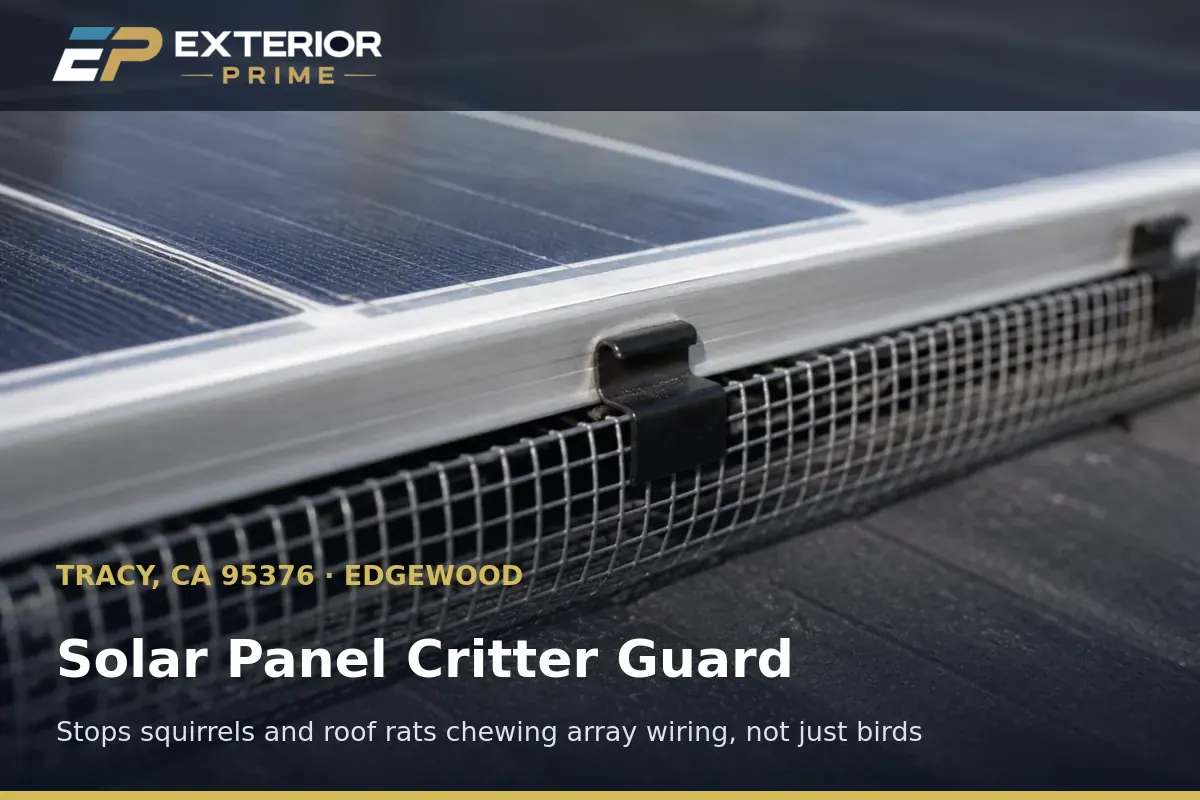
Critter guard uses a tighter weave and heavier gauge wire than bird mesh because rodents can gnaw through material that would simply stop a bird's beak.
A bird physically cannot chew through wire mesh; its beak isn't built for sustained gnawing the way a rodent's incisors are. Rodent-rated guard therefore needs to resist not just physical squeezing through gaps but active chewing pressure applied repeatedly to the same wire strand.
We use a heavier gauge for critter guard than for standard bird mesh in Tracy, since a squirrel's jaw strength can eventually wear through a lighter wire if given enough time and access. The tighter weave also closes the small gaps that a young roof rat, remarkably flexible-bodied, could otherwise squeeze through even where an adult couldn't.
Critter guard installation also pays closer attention to points where the array meets a roofline edge or overhanging tree limb, since that's the access route rodents use rather than direct flight the way birds do. We often recommend trimming nearby branches as a complementary step for full effectiveness in Tracy Hills and Sunrise Park properties with mature trees.
Despite these material differences, we install critter guard at the same $58-per-panel rate as bird mesh in Tracy, since the goal for most homeowners is comprehensive exclusion against both birds and rodents in a single project.
The Real Cost of Unprotected Wiring on a Tracy Roof
A single chewed wiring run beneath an unprotected Tracy solar array can cost far more to repair electrically than the entire critter guard installation would have cost upfront.
Solar wiring damage from rodents isn't always obvious immediately. A partially chewed insulation jacket can cause an intermittent fault that reduces system output gradually, meaning a Tracy homeowner might lose weeks or months of full production before diagnosing the cause, especially during peak summer months when energy bills are highest.
In more severe cases, exposed wiring from rodent damage creates a fire risk, since the confined, hot space beneath a solar array during a Tracy summer is exactly the kind of environment where a compromised electrical connection can become dangerous rather than merely inefficient.
Solar installers typically charge a service call plus diagnostic time to locate and repair chewed wiring, and that cost is frequently higher than the $58-per-panel critter guard rate would have been across an entire array, since electrical troubleshooting under panels is slow, careful work.
We regularly hear from Tracy customers who only called us after an inverter technician found chew marks during an unrelated service visit, at which point the electrical repair bill had already exceeded what full critter guard coverage would have cost from the outset.
Pricing and Coverage for Tracy Critter Guard Projects
Critter guard installation in Tracy is priced at $58 per panel, matching our standard mesh rate, with existing nest or debris removal starting at $200.
A 20-panel array, typical for many Tracy Hills and Redbridge homes, comes to $1,160 for full critter guard coverage. This single per-panel rate applies whether the primary concern is birds, squirrels, roof rats, or, as is common, some combination of all three pressuring the same array.
If we find evidence of established rodent nesting, such as accumulated nesting material or chewed insulation debris, cleanup and sanitation is quoted separately starting at $200, similar to our bird nest cleanup pricing, since both involve careful debris handling.
We recommend a full critter guard installation over partial coverage for Tracy homes near agricultural acreage, since a rodent will simply relocate to whatever section of the array remains unprotected rather than being deterred by a partial barrier.
The standard $297 minimum applies to standalone visits, though most Tracy arrays large enough to need full critter guard coverage exceed that minimum through panel count alone.
Which 95377 rooflines does solar panel critter guard inspect?
A 95377 solar panel critter guard visit measures 42 feet of soffit, downspout and siding edge around the array, then logs every eave opening our professionals seal.
solar panel critter guard on a 24-panel Berg Ranch roof takes about 24 minutes to map: 42 feet of soffit edge, 16 photographs, a 103 psi soft wash rinse across the mildew and screen below, and Central Valley heat noted in the 95377 file.
Edgewood and Plaza Park arrays fail the same way — Altamont Pass wind pushes grit under the siding, Delta breeze bakes oxidation onto the concrete and eave, so Exterior Prime folds that rinse into one solar panel critter guard appointment rather than a $297 second trip.
Exterior Prime records the 4-year workmanship history for 95377 and 95378 addresses, naming each downspout gap, concrete screen and oxidation deposit; a 24-panel job at $58 per panel is $1392, with cleanup from $200.