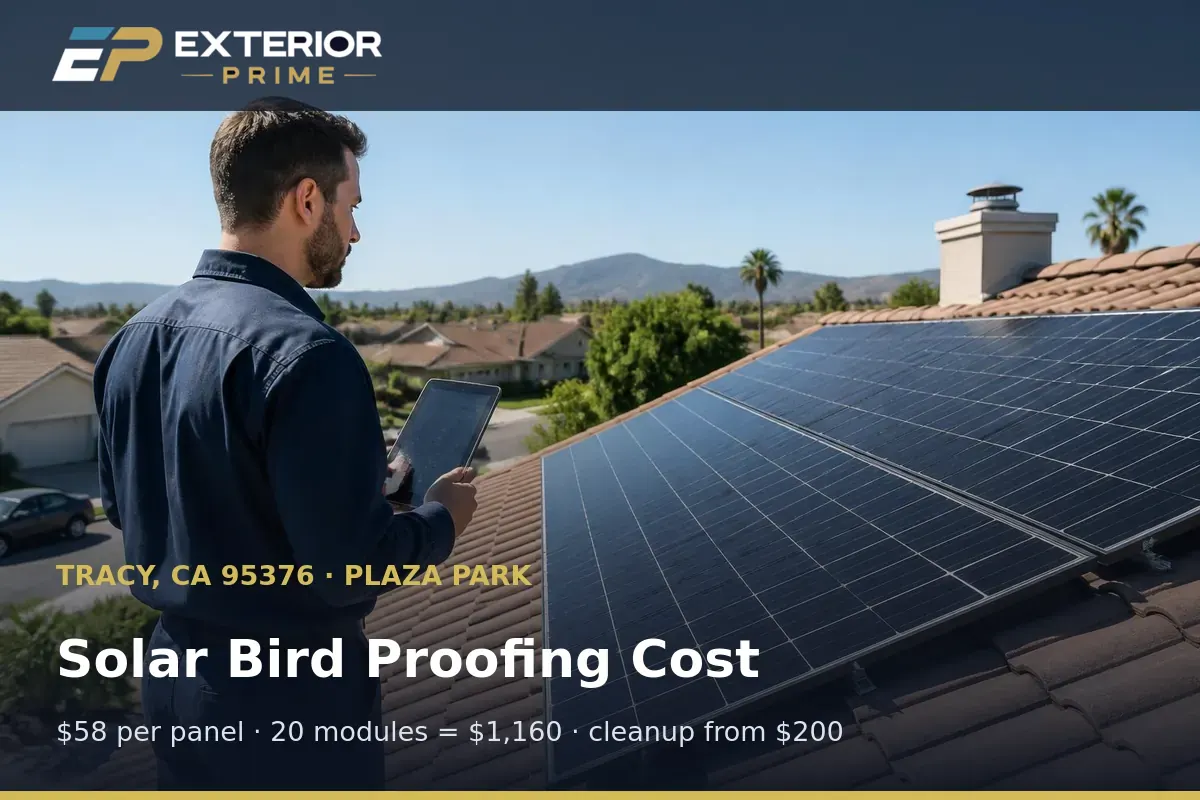
The $58-per-panel math behind every Tracy quote
Multiplying panel count by $58 gives the base installed cost before any adjustments for roof access or racking type.
A 10-panel array works out to $580, a 20-panel array to $1,160, and a 30-panel array to $1,740. This scaling stays consistent whether the home is in central Tracy near 95376 or the newer Tracy Hills growth area under 95377.
Because the rate is flat, homeowners can estimate their own cost accurately just by checking how many modules are on their system, which is usually listed on the original solar installation paperwork or visible in a monitoring app.
The $297 standalone visit minimum only comes into play on unusually small arrays, since a 5-panel system at $58 per panel would total $290, just under that minimum threshold, so the minimum applies rather than the lower per-panel math.
This structure means there's no guesswork or negotiation involved in the base price; the variable factors described below adjust the total from that fixed starting point rather than replacing it.
What raises the total above the base per-panel rate
Steep roof pitch, difficult access, and existing bird damage can add labor time beyond the standard installation rate.
Homes with steep or multi-plane roofs, more common in older sections of Downtown Tracy with varied rooflines, take longer to safely access and tension mesh across, which can extend labor time even though the per-panel rate itself doesn't change.
If birds have already nested under the array, cleanup starting at $200 gets added as a separate line item before proofing begins, since installing mesh over an active mess isn't something we'd recommend to any homeowner.
Arrays split across multiple roof faces, sometimes seen on larger Tracy Hills homes with panels on both the front and rear slopes, take more setup time than a single continuous array of the same total panel count.
Difficult ground access, like homes with limited driveway space near Grant Line Road's denser residential pockets, can occasionally add minor logistics time, though this rarely changes the quoted per-panel total itself.
What keeps the cost at the straightforward base rate
A single-plane roof with clear access and no existing bird activity typically prices out exactly at the $58-per-panel figure.
Newer construction in Tracy Hills with high-standoff racking on a single continuous roof face tends to install fastest, since the racking style is consistent and there's no need to work around existing nesting debris.
Homes with straightforward driveway and ladder access, common throughout much of 95376 and 95378, don't add any logistics time to the visit, keeping the job squarely within the standard per-panel pricing.
Scheduling during Tracy's slower winter months, ahead of spring nesting season, sometimes means less time pressure on a visit overall, though this affects scheduling speed more than the price itself.
For most Tracy homeowners calling before birds have moved in, the quote really is as simple as panel count times $58, with the finished total confirmed after a quick photo or phone-based estimate.
A worked pricing table for common Tracy array sizes
Here's exactly how the $58-per-panel rate scales from a small system up through a large residential array.
A 12-panel system, common on smaller Tracy tract homes near Southside, totals $696. An 18-panel system, a frequent mid-size configuration, totals $1,044.
A 24-panel system, often seen on larger Tracy Hills homes with higher electricity usage, totals $1,392. A 32-panel system, less common but present on some larger properties near the logistics corridor, totals $1,856.
These figures represent installed mesh coverage across the full array perimeter at the standard $58 rate, with no hidden add-ons unless cleanup or unusual access complicates the specific job.
Homeowners can use this table as a planning reference before requesting a firm quote, simply by matching their own panel count to the nearest example and adjusting the math from there.
How far past the modules does solar bird proofing cost reach?
A 95304 solar bird proofing cost visit measures 49 feet of downspout, algae and eave edge around the array, then logs every concrete opening our professionals seal.
solar bird proofing cost on a 23-panel Downtown Tracy roof takes about 30 minutes to map: 49 feet of downspout edge, 20 photographs, a 95 psi soft wash rinse across the oxidation and siding below, and San Joaquin County hardpan noted in the 95304 file.
Tracy Hills and Redbridge arrays fail the same way — Tule fog pushes grit under the eave, valley fog bakes fascia onto the mildew and concrete, so Exterior Prime folds that rinse into one solar bird proofing cost appointment rather than a $297 second trip.
Exterior Prime records the 5-year workmanship history for 95304 and 95377 addresses, naming each algae gap, mildew screen and fascia deposit; a 23-panel job at $58 per panel is $1334, with cleanup from $200.