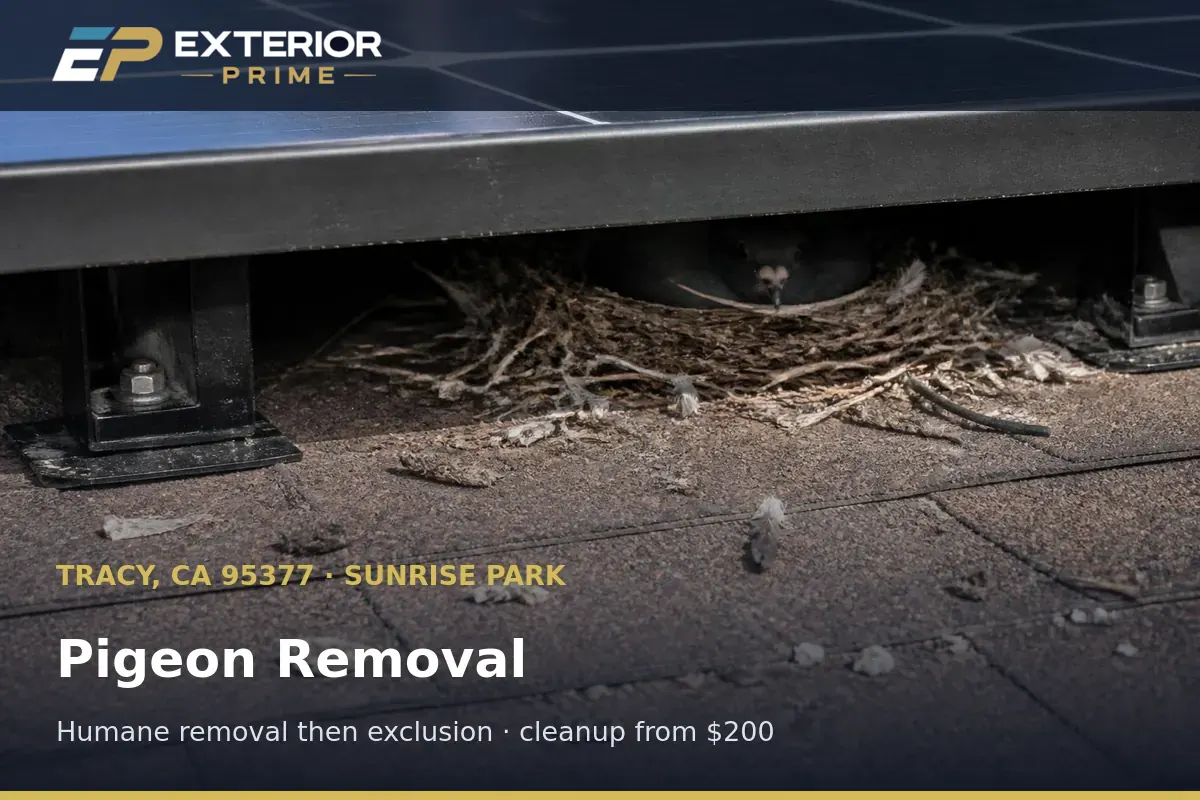
Why does removal alone always fail in Tracy?
Pigeons are strongly loyal to a proven nest site, so removing debris without sealing the gap almost always brings the same pair back to that exact spot within 30 days.
A pair that successfully raised a brood under a Tracy Hills array over the summer treats that gap as validated real estate, not a one-time stop. Even after our professionals clear out the sticks and droppings, the physical opening is still there, and pigeons remember it the way a commuter remembers a shortcut.
Scare tactics compound the problem because they don't address the opening at all. Reflective tape or a plastic owl might disrupt roosting for a few days near Plaza Park, but once the novelty wears off, and it usually does within two weeks, the birds settle right back in since nothing about the gap itself has changed.
Leftover scent and nest-cup shape also attract new pairs even if the original birds relocate elsewhere along Grant Line Road. A cleared but unsealed cavity can host an entirely different pigeon family by the next breeding cycle, which typically starts ramping up again by February in the Central Valley.
That's why every Exterior Prime removal call in Tracy is quoted alongside exclusion mesh from the start. Extraction handles what's already there; the mesh is what actually stops the cycle from repeating.
How does Exterior Prime sequence a Tracy removal job?
We inspect for eggs or chicks first, extract debris by hand once it's safe, sanitize the cavity for mites, then seal the gap with mesh before we leave.
Every job opens with a careful inspection using a mirror pole or a controlled panel-edge lift, since a Tracy homeowner calling in April is far more likely to have live chicks under the array than one calling in November, and disturbing an active brood too early creates a bigger mess than waiting a few days.
Once it's confirmed safe to proceed, our technicians extract debris by hand while wearing respiratory protection, since dried droppings can aerosolize easily in Tracy's dry summer heat and pose a real inhalation risk if handled carelessly. A typical first-season nest fills two to three contractor bags; a multi-year buildup near Southside can run considerably higher.
Sanitizing the cavity and racking rails comes next, targeting residual mites that survive even after the birds and nest material are gone. Skipping this step and sealing mesh over live mites just relocates the infestation into nearby attic insulation instead of solving it.
Only after extraction and sanitizing does the exclusion mesh go on, cut to match the roof plane and clipped to the panel frame with stainless hardware. Closing the gap on the same visit means there's no window for the same pair to reclaim the cavity overnight.
Is removing a pigeon nest in Tracy legal?
Feral pigeons aren't federally protected, but our professionals still verify there are no flightless chicks or eggs present before any extraction begins on a Tracy roof.
Unlike native songbirds, feral pigeons don't carry protections under the Migratory Bird Treaty Act, which is a common misconception among Tracy homeowners who assume every nest is untouchable. Even so, we handle every job the same careful way regardless of species assumptions.
Breeding activity in the Central Valley generally runs February through October, with a heavier spring push and a smaller second wave once the worst of Tracy's July heat eases. That window shapes our timeline more than anything else, sometimes pushing extraction back a week or two to let near-fledged chicks leave on their own.
Every nest gets photographed before removal starts, both to plan the safest extraction method and to give the homeowner a documented record of what was actually living under their array near the logistics corridor.
What does pigeon removal cost for a Tracy home?
Debris volume sets the cleanup price starting from $200, mesh installation adds $58 for each panel, and a full-service job on a typical Tracy array lands between $900 and $1,700 overall.
A single-season nest on a newer Tracy Hills build usually clears faster and cheaper than a multi-year colony on an older Downtown Tracy roof with several active gaps across different planes, since the debris volume and mite load both scale with how long birds have been established.
The $297 standalone minimum only applies if removal is requested on its own with no follow-up mesh; nearly every Tracy homeowner bundles extraction, sanitizing, and exclusion into a single visit, which is both cheaper and far more effective long-term.
Why does pigeon removal solar panels start at the paver line?
A 95377 pigeon removal solar panels visit measures 70 feet of gutter, roof and soffit edge around the array, then logs every downspout opening our professionals seal.
pigeon removal solar panels on a 14-panel Edgewood roof takes about 36 minutes to map: 70 feet of gutter edge, 20 photographs, a 79 psi soft wash rinse across the screen and stucco below, and valley fog noted in the 95377 file.
Plaza Park and Berg Ranch arrays fail the same way — agricultural dust pushes grit under the soffit, Tule fog bakes siding onto the algae and downspout, so Exterior Prime folds that rinse into one pigeon removal solar panels appointment rather than a $297 second trip.
Exterior Prime records the 4-year workmanship history for 95377 and 95376 addresses, naming each roof gap, algae screen and siding deposit; a 14-panel job at $58 per panel is $812, with cleanup from $200.