A
What A Correct Installation Sequence Looks Like
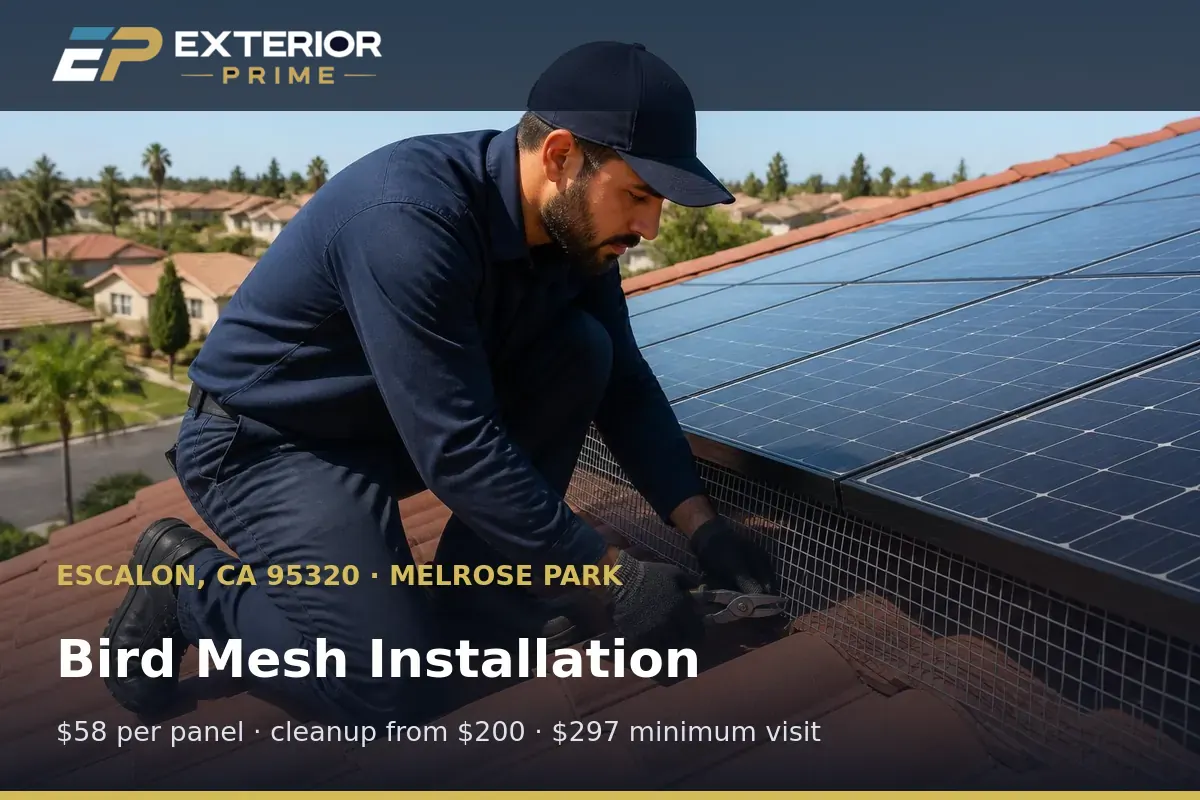
The frame is measured first, mesh is cut to fit the true array outline, then clamps go on last around every edge.
Most failed mesh jobs we see in Escalon started backward: someone rolled mesh across the rack, then trimmed whatever hung over the edge. That leaves loose corners exactly where a pigeon lands first. A correct installation measures every rail, module gap and conduit run on the roof before a single clamp gets set.
Once measurements are logged, mesh is cut to the array's actual perimeter rather than a stock roll width. On Reed Manor and Silverwood homes with mixed retrofit and newer racking, that custom cut is often the difference between a sealed cavity and one with a two-inch gap at the eave return.
Clamps go on last, spaced roughly every 12 inches along the frame lip. Exterior Prime professionals dispatch from Manteca with pre-measured stock so a typical single-plane Escalon roof is finished in one visit without a second cutting-pass appointment.
B
Why Does Installation Quality Matter More In Escalon?
Almond and walnut orchards ringing Escalon keep bird pressure high year-round, so any installation gap gets tested almost immediately.
Escalon isn't a quiet suburban grid the way some nearby towns are. Orchard blocks surrounding the city limits, plus grain handling near Jones Road, support a resident bird population that doesn't thin out in winter the way it might elsewhere in Stanislaus County.
That means a mesh installation with even one soft corner gets probed within days, not months. We've reinstalled failed jobs on Brentwood Estates roofs where the original mesh sagged after six weeks because clips were spaced too far apart to hold tension through a windy afternoon.
Tule fog winters add another layer. Damp mornings settle on rooftops for hours, and a poorly galvanized clip corrodes faster under that daily cycle than it would in a drier climate, so installation hardware choice matters as much as the mesh itself.
C
Fastening Method And Warranty Coverage
Spring clamps grip the aluminum module frame only, leaving the roof deck and panel glass untouched and warranty intact.
Nothing in a correct installation touches your roof shingles or the panel's glass surface. Every clip grips the extruded aluminum frame edge, transferring load to the array's own structure instead of the roofing underneath, which keeps both your solar manufacturer warranty and your roof warranty untouched.
Exterior Prime backs the completed installation with a five-year workmanship warranty covering clips and seams. If a clamp lifts or a seam opens within that period, a return trip corrects it at no charge, which matters given how many DIY guard failures we inspect each spring around Vintage Estates.
Conduit and microinverter housings get individually routed around rather than covered over, since sealing airflow paths can raise panel temperature during a 100-degree July stretch and shave a little off system output.
D
Scheduling An Installation Around Escalon's Calendar
Late winter installs beat spring nesting season and keep cleanup volume low before hulling dust arrives in fall.
Booking an installation between December and March means the barrier goes up before pigeons start scouting nest sites for the season, which avoids a cleanup call a few months later. It also means less debris to clear before mesh goes on, since winter roofs carry less accumulated material than one that's hosted a summer of roosting.
September and October bring almond and walnut hulling dust that settles into any open joint on a roof, so scheduling ahead of that window keeps the newly clamped mesh cleaner longer. A rinse-down after hulling season is a quick add-on rather than a full re-service.
Even mid-summer installs go ahead without issue; active nests are simply worked around, with reachable material cleared once fledglings move on before the final seam closes.