A
What solar panel bird proofing actually involves
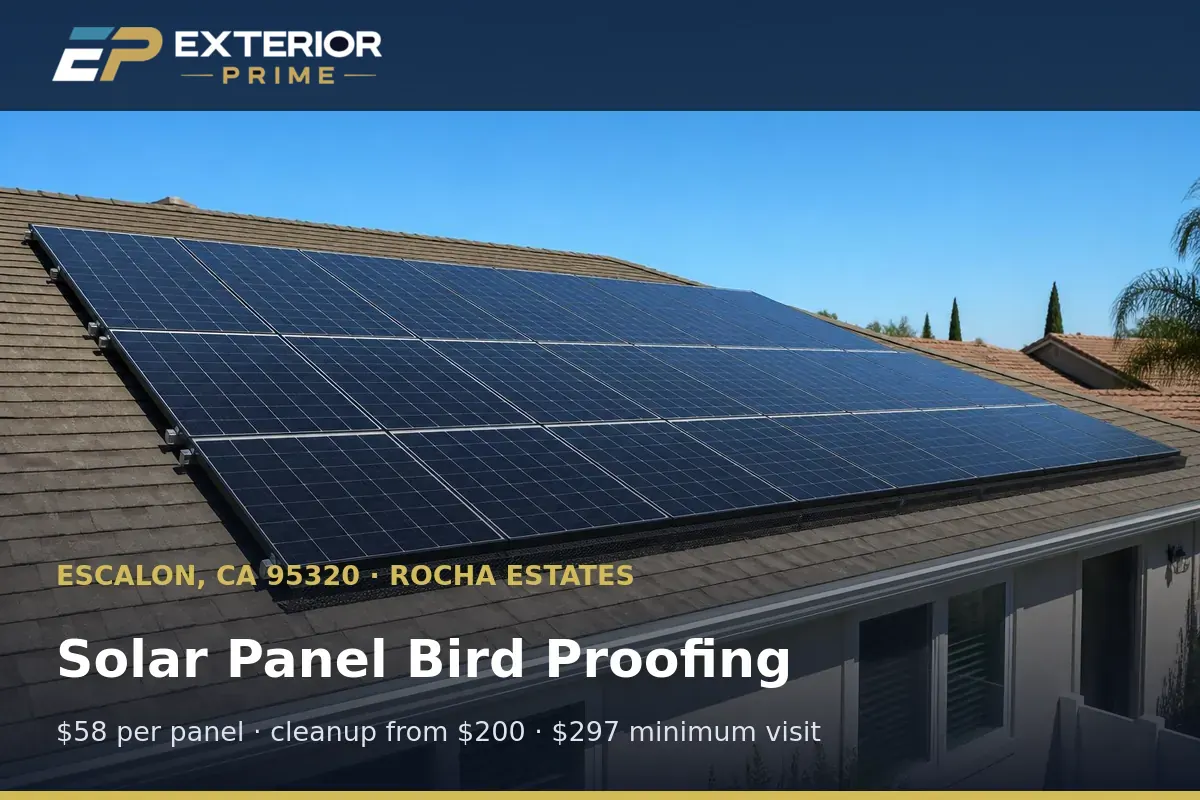
The process pairs a clamped mesh barrier around the array perimeter with cleanup of any existing nesting material underneath.
Each module sits 3 to 6 inches above the roof deck to allow airflow, and that gap is exactly what pigeons look for. Exterior Prime professionals measure the full perimeter of the array, cut galvanized mesh to match, and clamp it to the aluminum module frame using stainless clips rather than screws through the panel or roofing material.
Before the mesh goes on, any existing droppings, feathers or nesting debris are cleared from the cavity and sanitized, since sealing birds inside an occupied space is never the goal. This matters on Escalon roofs where a nesting pair has sometimes been active for more than 2 breeding seasons.
The finished barrier follows the array's outline exactly, leaving no gap wider than 0.25 inch at corners or where the racking meets the roof edge. Conduit runs and microinverter housings inside the cavity are worked around rather than covered over, so maintenance access is not blocked.
B
Why do Escalon arrays specifically attract birds?
Nearby almond and walnut orchards support a year-round bird population that treats warm, dry rooftop gaps as prime real estate.
Feed spill and hulling operations near town keep pigeons and other birds active through all 12 months, unlike colder regions with a clear winter lull. That means an Escalon roof rarely gets a natural break from rooftop pressure the way homes 20 or more miles from agricultural land might.
The underside of a module stays warm after summer heat and dry through winter Tule fog, which makes it more appealing than a nearby tree or barn rafter for a breeding pair. Once one pair succeeds, the site tends to attract repeat use across multiple breeding cycles.
Homes closer to Escalon-Bellota Road, Jones Road and the Main Street side of the orchard perimeter tend to see this pressure earlier in the season than homes further into the town grid, though every unsealed array in San Joaquin County’s 95320 ZIP is eventually at risk.
C
Why frame-clamping protects your warranty
Fastening the barrier to the module frame instead of the roof avoids the drilling that voids many solar warranties.
Most panel manufacturers specifically restrict new penetrations into the racking or roof deck for the first 10 to 25 years of coverage, since each hole is a potential leak path. Clamps that grip the aluminum module frame carry the full weight and wind load of the mesh without touching the roof at all.
The mesh itself is galvanized steel chosen to resist corrosion through damp Escalon winters, and stainless spikes can be added along ridgelines where birds continue perching outside the array boundary. Every clamp point is checked during the final walk-through before the seam is closed.
This approach also protects the roofing warranty on tile or shingle underneath the array, since nothing new is fastened through either surface. It is the same reason Exterior Prime can offer a 5-year workmanship warranty on the clips and closing seams without qualification.
D
Signs an Escalon array already needs attention
Staining, sound and a drop in output are the three most common signs birds have already moved in under the panels.
Chalky white droppings tracking down siding below the array, straw appearing in gutter outlets, and cooing audible through the ceiling at dawn are the earliest signs most Escalon homeowners notice within the first 2 weeks. Any one of these usually means a nest is already established rather than birds simply perching nearby.
A drop in solar output of 10% or more that does not match seasonal expectations is a quieter sign, since shaded or blocked cells underneath nesting debris produce less power without an obvious visual cue on the roof itself.
Ectoparasites like mites occasionally travel indoors from an established nest through attic gaps, which is usually the point homeowners near Main Street or Jones Road finally call Exterior Prime rather than waiting through a second breeding cycle.