What mesh gauge and clip spacing does Exterior Prime actually use?
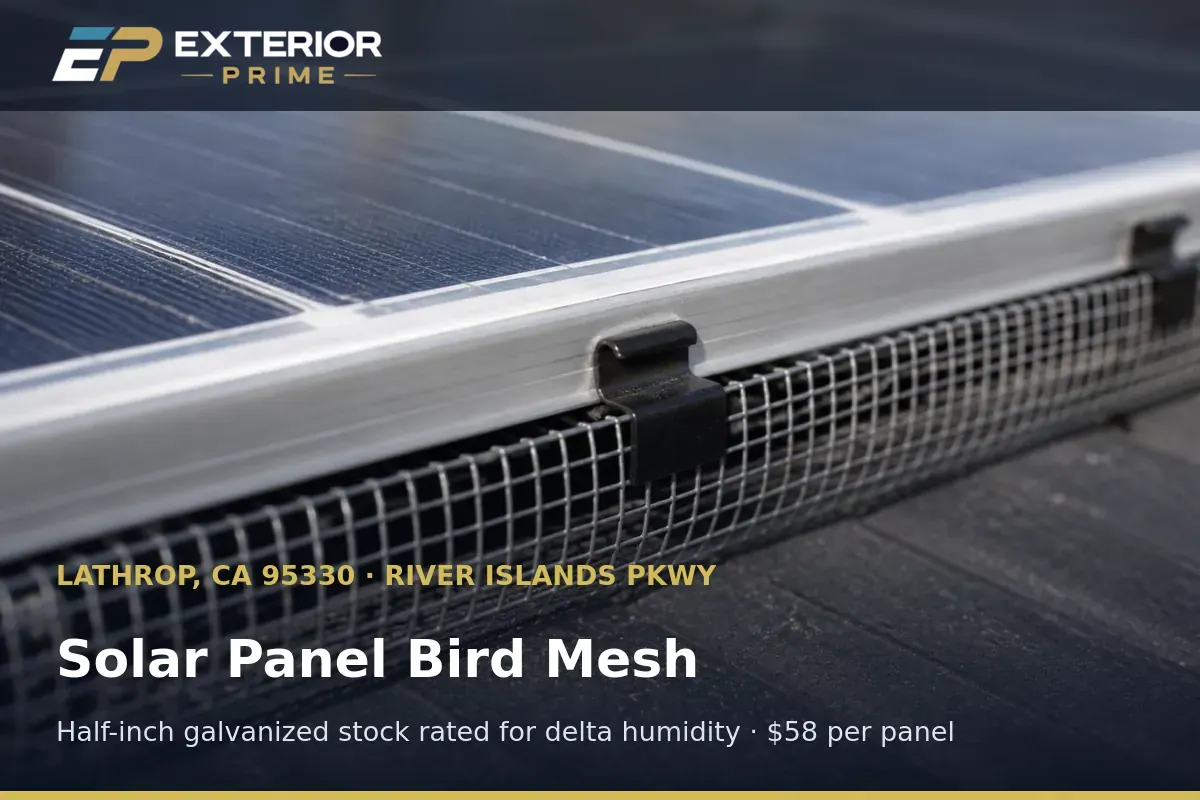
Exterior Prime installs half-inch aperture galvanized wire mesh with stainless steel clips spaced roughly every 12 to 18 inches around the panel perimeter.
The half-inch aperture matters because it is small enough to stop pigeons and even most sparrows from squeezing through, but open enough to keep air moving under the modules so heat doesn't build up around the inverter wiring and conduit. We've measured too many Lathrop roofs, from the newer builds off Golden Valley Parkway to the older shingle homes near Lathrop Road, where a coarser mesh let birds back in within a season.
Clip spacing depends on wind exposure. A Stonebridge home on an open lot facing prevailing delta wind gets clips every 12 inches; a more sheltered Mossdale Landing rooftop tucked between two-story neighbors can run 18 inches without sagging. Every clip is stainless, not zinc-plated steel, because galvanic corrosion between dissimilar metals is a real problem after a few Central Valley summers of 100-degree heat followed by winter tule fog condensation.
For a typical 22-panel array we use roughly 60 linear feet of mesh and 45 to 55 clips. We hand-count that during the survey rather than eyeballing it from a satellite photo, because roof pitch and panel spacing vary block to block even within the same River Islands phase.
None of this involves drilling into the panel frame or the roof. The clips grip the existing aluminum lip of the module, which is why the racking and module warranties stay intact after installation.
How much mesh does a Lathrop roof actually need?
Linear footage scales with array perimeter, not panel count alone, so two 20-panel arrays in Lathrop can need very different amounts of mesh.
A single-row array of 20 panels laid out in one long line along a Historic Lathrop composition-shingle roof might only need 55 linear feet of mesh because most of the perimeter runs along two long edges. Split that same 20 panels across two roof planes at a Woodfield two-story, and you're often closer to 80 linear feet because there are more corners and edges exposed to birds.
We calculate this on-site with a tape measure and a photo log, then confirm the number before charging. Most Lathrop quotes land between $700 and $1,400 total, and a straightforward 20-panel single-plane array runs close to $1,150 in materials and labor combined.
Multi-plane roofs, common on the newer three-and-four-bedroom River Islands floor plans, typically add 15 to 20% more linear footage than a single flat expanse of panels. We flag that during the free estimate, not after the invoice.
If your array already has a few open gaps from a partial installation years back, we measure those separately rather than re-quoting the whole roof, which keeps add-on pricing fair for homeowners who only need patch coverage.
Does bird mesh void my solar or roof warranty?
No — Exterior Prime mesh clips to the module frame with no roof penetrations, so both the roofing warranty and the panel manufacturer's warranty stay intact.
Solar installers in San Joaquin County generally void roof-attachment warranties the moment someone drills a new hole into the deck or the racking. Our clip-on method avoids that entirely — the stainless clips hook onto the aluminum frame edge that's already there, the same edge the racking itself uses to hold the module down.
We also back our own work with a five-year workmanship warranty on the treated exclusion zone, covering the mesh and clips specifically, separate from whatever warranty your solar installer already provided when the array went up off Louise Avenue or Dos Reis Road.
Homeowners in Lathrop sometimes ask if the mesh interferes with microinverter cooling. It doesn't — the aperture is large enough for airflow, and we route the mesh line clear of any conduit runs or junction boxes so a technician can still service the inverter without cutting mesh.
If your panels are still under a manufacturer's original installation warranty, we're happy to email photos of the finished clip work so you have documentation on file in case a question ever comes up during a future roof or panel service call.
What time of year should Lathrop homeowners install bird mesh?
Late winter through early spring, before nesting season peaks, is the ideal window, though Exterior Prime installs mesh year-round across Lathrop.
Pigeons in the San Joaquin delta corridor typically start scouting nest sites in February and March, well before Central Valley temperatures climb into the 90s. Installing mesh in January or February, while tule fog still lingers over Lathrop mornings, means the barrier is already in place before a breeding pair picks your array over a neighbor's.
That said, we don't turn away summer or fall jobs. A hot August install just means our professionals start earlier in the day to avoid working on a panel surface baking at well over 140 degrees by noon, which is standard practice near Highway 99 in July and August anyway.
If you already have an active nest, we handle droppings and nest-debris cleanup starting from $200, quoted after we survey the roof, before any mesh goes on. Installing mesh over an active nest just traps birds under the array, which nobody wants.
Whatever the season, most installs on a typical Lathrop home wrap up in three to five hours, so it rarely requires more than a single afternoon appointment.