01
What actually collects on the roof deck below your Salida array?
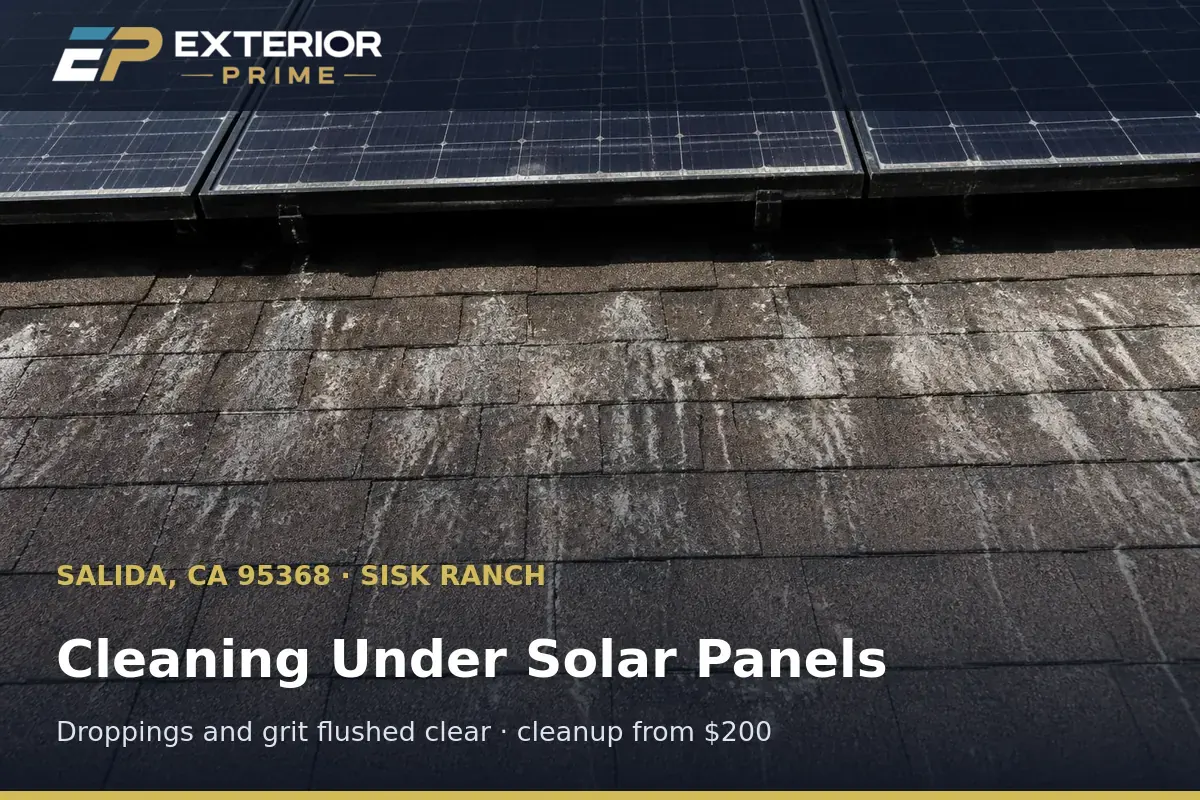
Debris under a Salida solar array is a mix of almond hulling dust, dried leaves, feathers and hard-water mineral grit that never gets rinsed away by rain.
Because the panels themselves act as a roof over the roof, the deck underneath stays dry for 10 or 11 months of the year, which sounds good until you realize it means nothing ever washes the debris off naturally the way an exposed roof section does during Salida's December-February rains. Exterior Prime professionals see 2-4 years of buildup on a typical first-time visit.
On Kiernan Avenue and Highway 99 frontage properties, dust and light debris from passing traffic and the nearby rail line settle into that dry pocket faster than on quieter interior ZIP 95368 streets, adding another layer to what accumulates over a typical 12-month cycle.
Hard well water used for irrigation in some Salida yards also contributes mineral spotting that drifts onto lower roof sections and, eventually, under panel edges, compounding with 6-8 weeks of hulling dust each fall into a stubborn combined layer. Exterior Prime professionals treat this layer as part of the standard visit, not an upsell.
02
How do you clean the roof deck and module undersides properly?
A real under-panel cleaning treats the roof deck surface and the module underside as two connected but distinct cleaning tasks.
The roof deck gets swept and, where needed, gently scrubbed to lift compacted debris without disturbing tile or shingle granules, which matters most on the older composition shingle roofs common across Salida's 1970s-1990s tracts.
Module undersides are wiped to remove dust film and any droppings residue that has drifted upward from below, since airflow restriction under a dirty array traps heat and can slightly reduce panel efficiency during Salida's hottest July and August afternoons.
Mounting rails and clips are checked during the same pass, since debris buildup around hardware can trap moisture during winter Tule fog mornings even though the space stays dry most of the year, occasionally leading to light corrosion on older installs.
03
How much output recovery do homeowners actually notice?
Clearing debris and improving airflow under a dusty Salida array can recover a modest but real slice of lost solar output.
Panels run more efficiently when they run cooler, and trapped debris under the array insulates the underside slightly, which can nudge operating temperature up by several degrees during peak summer hours above 100°F. Clearing that layer restores normal airflow and can shave 3 to 5 degrees off panel temperature on a hot afternoon.
Homeowners who have not cleaned under their array since a mid-2010s solar retrofit sometimes notice a visible uptick on their production monitoring app within the first 7 days after the service, particularly if hulling-season buildup had been accumulating for 2 or 3 years.
On Pirrone Estates and Sisk Ranch roofs where microinverters and junction boxes sit tucked beneath the modules, clearing that debris also keeps hardware ventilated, and the soiling loss homeowners were quietly absorbing — often 2 to 4 percent of annual kWh — comes back without any equipment change. It is not a dramatic transformation on every roof, but on a neglected Salida array it is a measurable improvement that leaves a drier space under the panels going into the next fog season.
04
Should you combine under-panel cleaning with a panel wash?
Most Salida homeowners book under-panel cleaning together with a full glass wash so both jobs happen in a single mobilization.
Since an Exterior Prime professional is already on the roof lifting access points to reach under the array, adding the top-side glass wash to the same 2-3 hour visit avoids paying for a second $297 mobilization and lets both the visible dust on the glass and the hidden debris underneath get handled at once.
This combination works especially well right before or after almond hulling season, when both the top of the array and the space underneath are collecting debris from the same source, so cleaning them together makes practical sense rather than scheduling two separate Salida appointments.
If exclusion mesh is not yet installed, this same visit is also the natural time to add it, since the array is already open and accessible, closing the loop between cleaning the mess and preventing it from returning.