01
Why Removal Comes Before Exclusion On A Salida Roof
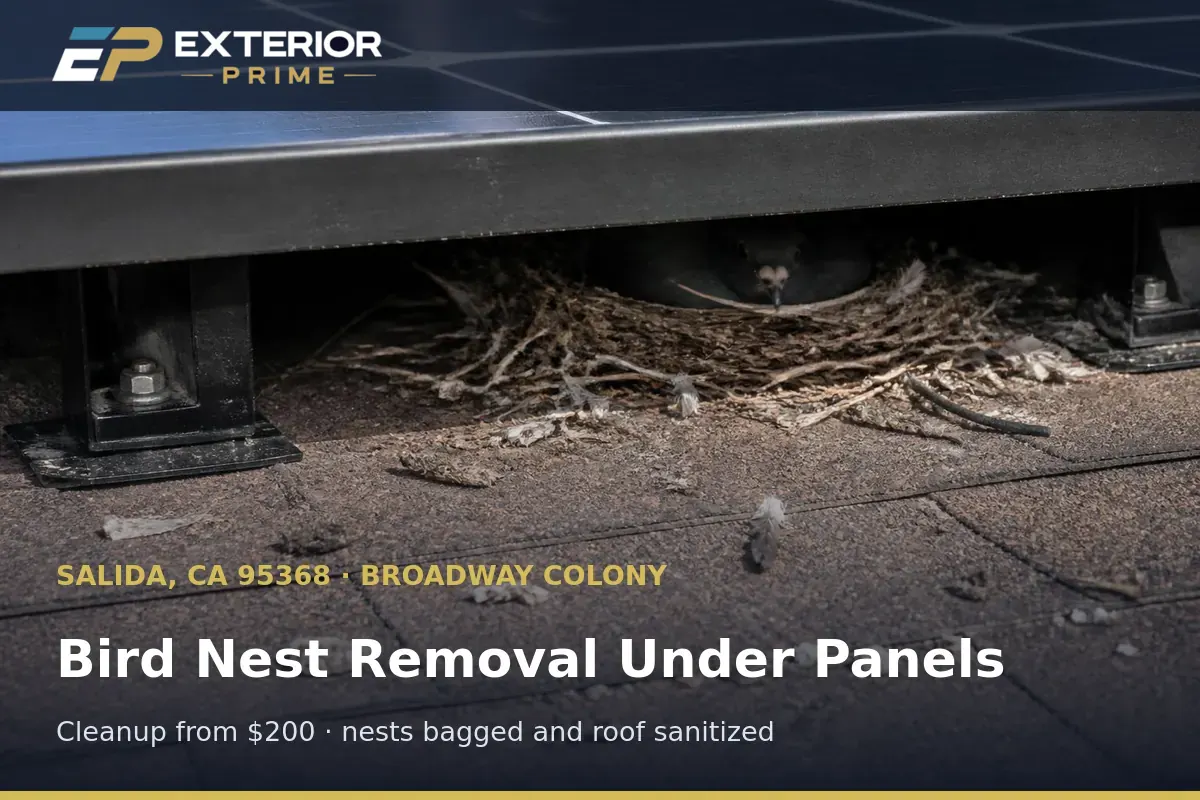
Installing mesh over an active nest traps birds and droppings underneath instead of solving anything.
It sounds efficient to just seal the array shut and be done with it, but sealing an active nest inside creates a worse problem: trapped adult birds, unhatched eggs or dead material left to decompose under panels you can't easily reach again. That's why every Exterior Prime job in Salida 95368 starts with confirming whether a nest is active before any mesh goes on.
Exterior Prime professionals check for movement, fresh droppings and nesting material staging, which tells us whether birds are actively using the space under a given array in Salida or whether it's an old, abandoned nest from a previous season. That distinction changes the order of operations for the visit.
Once Exterior Prime professionals confirm the space is clear, cleanup and exclusion happen in the same trip whenever possible, so you're not paying for two separate visits and two separate mobilization fees on your Kiernan Avenue or Prescott-area home.
02
What Cleanup And Sanitation Involves
Removal covers nesting debris, dried droppings and any built-up material, followed by a sanitizing wipe-down of the racking.
Nest material under a solar array isn't just twigs. Over a season or two it accumulates into a dense mat mixed with feathers, droppings and dust, especially on arrays near the almond blocks along Hammett Road where hulling debris August through October adds to the pile.
Removal means physically clearing that material by hand from under the rack, bagging it, and sanitizing the affected racking and roof surface afterward. Dried pigeon droppings carry health risks when disturbed, so our professionals use proper protective equipment and wet the material down before disturbing it to control dust.
Cost scales with volume because a single-season nest under one panel takes far less time than a multi-year buildup spanning a whole array corner, which is why removal pricing starts from $200 rather than a flat number across every Stanislaus County property we service.
03
Legal And Humane Timing Around Breeding Season
Active nests with eggs or chicks during breeding season generally must be left until fledging before removal proceeds.
Spring pigeon breeding season starts around March in Salida and can run into summer with overlapping clutches, and removing an active nest with eggs or dependent chicks during that window raises both legal and ethical concerns depending on species. Migratory bird protections can apply even when a nest looks like a simple pigeon build, and Delta breeze patterns typical of Stanislaus County don't change that legal timing.
When our professionals find an active nest with eggs or chicks during a spring visit, the responsible approach is to document it, advise the homeowner on timing, and schedule cleanup and exclusion for once the young have fledged rather than disturbing an active brood.
This is also just practical. A nest cleared before chicks are gone typically gets rebuilt within days by the same returning pair, so timing the full removal-plus-exclusion job around fledging avoids paying for the same job twice on the same Sisk Ranch or Pirrone Estates roof.
04
How Do You Stop Repeat Nesting After Cleanup?
Cleanup without mesh exclusion afterward almost always results in a new nest within a few weeks.
We've returned to Salida homes where a homeowner cleared a nest themselves, left the area open, and had a new nest rebuilt under the same panel corner within three or four weeks. Pigeons are strongly site-loyal and will return to a proven nesting spot unless the opening itself is closed.
That's why every removal job we quote includes an exclusion recommendation using $58-per-panel galvanized mesh fitted around the same area, sized to close the specific gap the birds were using rather than the whole array if only one section is affected.
For homeowners on a tighter budget, we can phase the work, cleanup now and mesh later, but we're upfront that the gap stays open and vulnerable to a new nest in the meantime, particularly heading into another March breeding season.
After the nest material leaves the roof, Exterior Prime professionals sanitize the deck and module undersides to knock down guano-borne mites and other ectoparasites, then trace conduit and eave gaps that make convenient secondary perch points. Stainless clips hold the galvanized barrier at every roosting edge, and the 5-year workmanship warranty covers those clips for as long as the array stays in place.